Article number Z998
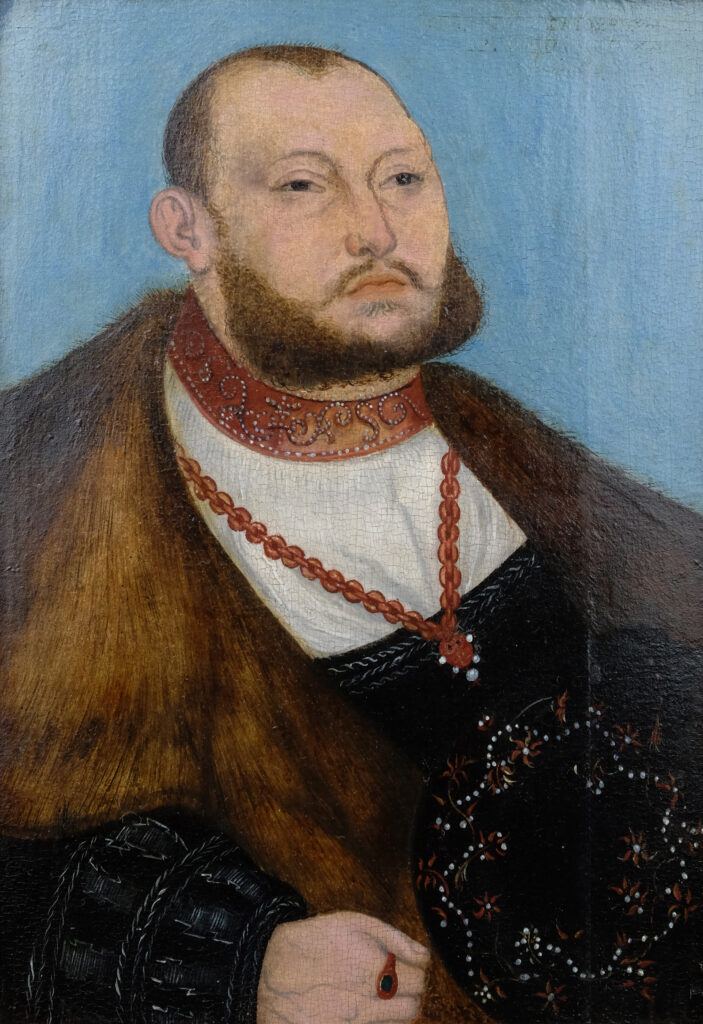
Portrait of Elector John Frederick of Saxony
Stroganov collection, St Petersburg

Catalogue
Cabinets of art or wonder, often also called cabinets of rarities and curiosities, are the nucleus of today’s museums. With the dawning Enlightenment and the urge for discovery, individual private collections emerged in Europe from the 15th century onwards, bringing together various curiosities from art, craftsmanship, science and nature with the aim of grasping the “connection of things” and being better able to explain the secrets of the world. Wealthy aristocrats and affluent members of the bourgeoisie stored fascination, values and knowledge, but also secrets, in their collections for their descendants and for posterity. The Kunstkammern are authentic witnesses to the possibilities and limits of human knowledge and humanist cultures in the Gothic, Renaissance and Baroque periods. They consist of colourful mixtures of the most diverse treasures. Classic treasury objects such as gold, silver, glass, porcelain and coins were enriched with artefacts, corals, minerals, animal specimens, carvings, objects of alchemy and memento mori, technical instruments or scientific writings, enhancing the collection as such.
The driving force and motivation of such collections was always the fascination for rarities and curiosities, which had their origins on the one hand in medieval roots, legends and stories, but also in humanist influences and technical and scientific discoveries.
Alongside the representative treasures from Kunstkammern, in this catalogue we also focus on functional craftsmanship, whose objects primarily had to fulfil a practical purpose, but which were nevertheless often lovingly designed, decorated, painted, engraved, chased or carved with great spirit, heart and expertise, without this enhancing their classic function. It was probably the appeal of and appreciation for the special, as well as the longing for beauty and aesthetics, that motivated craftsmen in Europe to fantastic achievements – driven, of course, by the purses of those who not only appreciated the exclusive but could also afford it.
Antiques or selected individual objects are still an expression of individuality today. They fascinate through their uniqueness and the stories they have experienced over the centuries, which we can only begin to imagine today. A casket was meant to hold or hide personal treasures. With a mortar, solids were crushed and ground into powders. A two-handed sword served in battle to clear a path. With a goblet, people toasted each other and drank from it. A bell was meant to ring out far across the land. Their beauty and patina have turned all these objects into coveted works of art and collector’s items. What remains for us is that we can still enjoy the beauty of old craftsmanship today.