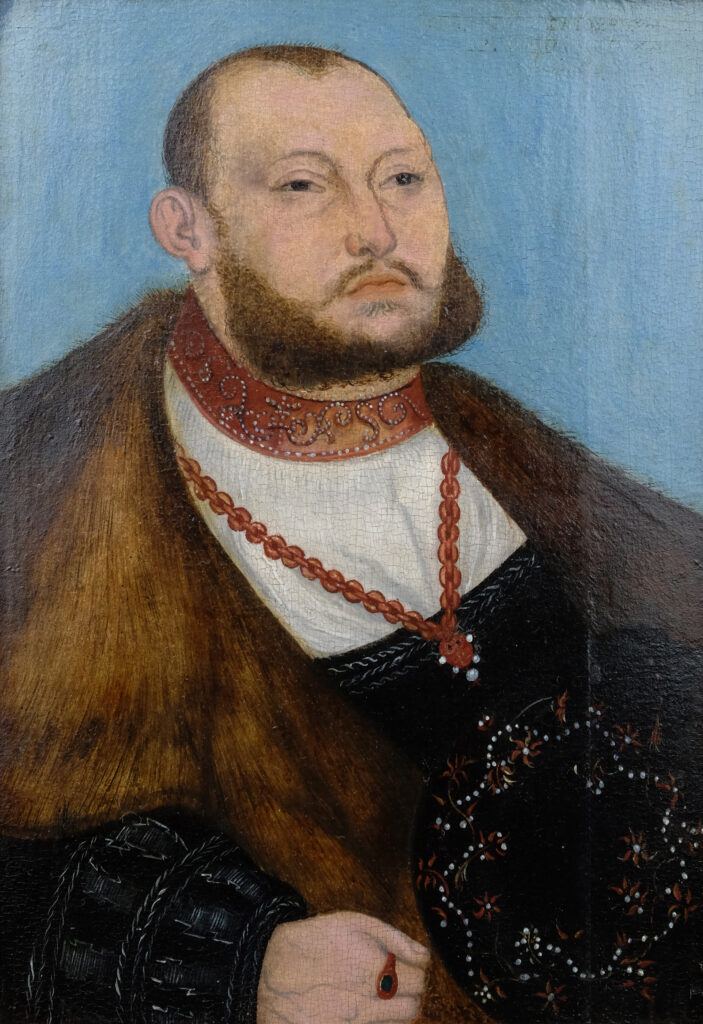
Portrait of Elector John Frederick of Saxony
ARTIST
Lucas Cranach the Elder (1472-1553), workshop of
PORTRAIT
John Frederick I, known as the Magnanimous, Elector of Saxony (1503-1554)
ORIGIN
Wittenberg, c. 1535
TECHNIQUE / SUPPORT
Oil on beech wood, white chalk ground.
Restored and framed in a matching wood/stucco frame from the 18th/19th century.
DIMENSIONS
Panel 20 x 14 cm; frame: 32 x 26 cm.
SUBJECT
Half-length portrait of the Elector in three-quarter profile facing right against a blue-grey background, holding his fur collar with his right hand. On the index finger of this hand he wears the electoral ring.
Lucas Cranach the Elder and his workshop portrayed the Saxon Elector John Frederick (1503-1553) several times. The present painting comes from the Stroganov collection. It repeats a type of portrait showing the Elector as a half-length figure with a pearl-embroidered collar and fur muff in his hands against a blue background.
Three portraits of this type are known and are attributed to Lucas Cranach the Elder and his workshop: the portrait of the Elector from Güssing Castle in the Landesgalerie Burgenland, Eisenstadt. Its companion piece shows the Elector’s wife, Sibylle, Electress of Saxony, and is dated 1535 (see Cranach Digital Archive, ID AT_LGB_128). Two further versions have an almost identical format to the present portrait: the pair of paintings of the Elector and Electress from Gotha Castle, also dated 1535 (Cranach Digital Archive, ID DE_SMG_SG13), and the pair of paintings signed with the serpent device in the Veste Coburg (DE_KSVC_M021), dated c. 1536.
ABOUT THE ARTIST
Lucas Cranach was appointed court painter by the Saxon Elector Frederick the Wise in 1504. In 1505 he opened his workshop in the residence town of Wittenberg. Until his death the artist also served the two subsequent Saxon Electors, John the Steadfast and John Frederick the Magnanimous. He was a close friend of Martin Luther, and his artistic work was of great importance for the spread of the Reformation.
ABOUT THE ELECTOR
John Frederick I, known as “the Magnanimous” (1503–1554), was Elector of Saxony from 1532 to 1547 and thereafter Duke of Saxony. He was an important supporter of the Reformation and a patron of Martin Luther. He lost his electoral dignity and part of his lands after being taken prisoner at the Battle of Mühlberg in 1547, but retained his magnanimity by founding the Hohe Schule in Jena while in captivity, which later became the university. He received his epithet “the Magnanimous” for his commitment to the Reformation and as a patron of Martin Luther. After five years of captivity he was released thanks to the Peace of Passau and spent the last years of his life in Weimar, where he was also buried.
SIGNATURE & DATING
A repeated “S” in the pearl embroidery of the collar. Remains of an inscription at the top right: “JOHANNN FRI(…)”, indicating that this portrait comes from a portrait series.
EXPERT OPINIONS & STATEMENTS
Prof. Dr. Gunnar Heydenreich, Diana Blumenroth, CICS, TH Köln, examination report 23-0554, 2 October 2023. The technical art-historical examination of the panel by Prof. Dr. Heydenreich helped to clarify the question of attribution. He considers it possible that the painting was created in the Wittenberg Cranach workshop.
“However, particularities in the underdrawing and use of materials do not rule out that it was created in the circle of the workshop or at a later date. Some design elements, such as the chain, the borders of the garment and the electoral ring, show similarities with works by the Master I.S. The Master I.S. also still underdrew portraits with a liquid drawing medium and similar stylistic features in the 1560s.”
Heydenreich suspects that the painting was part of a portrait series. This is indicated by the partially preserved inscription “JOHANN FRI…” at the upper edge. He draws a comparison with the portrait series by the Master I.S. from around 1560 in the Gotha Kunstkammer of Ernest the Pious (Cranach Digital Archive DE_KSVC_M024).
TECHNICAL EXAMINATION METHODS
– Stereomicroscopy
– XRF analysis (Niton XL3t GOLDD+)
– UV examination
– X-radiography (Oehm u. Rehbein, Leonardo/ Varex-Perkin Elmer XRPad2 4336)
– Infrared reflectography (Osiris, 900-1700 nm)
CONDITION
Visually in good condition. The panel, consisting of two boards, is glued with vertical grain (visible on the reverse). The reverse of the panel has been sanded and covered with a contemporary manuscript on paper. Among other things, the manuscript contains a reference to “Carol V.”, Emperor Charles V, which is an indication of the authenticity of the sheet.
Prof. Heydenreich’s extensive examinations revealed a number of abrasions and damages not visible to the naked eye, particularly in the flesh tones and the beard. The original inscription at the upper right edge has largely been removed. No significant changes to the original composition of the painting are discernible.
FRAME
Decorative wood/stucco frame of the 18th/19th century. The plaque on the lower edge of the frame refers to Lucas Cranach the Younger (dates 1515-1586), an attribution not confirmed by Prof. Heydenreich.
PROVENANCE
- Stroganov collection, St Petersburg – handwritten label on the back of the frame.
Alexander S. Stroganov (1733–1811), important collector and patron of the Russian Enlightenment. Stroganov travelled in Western Europe and studied in Geneva and Paris. In Paris he formed close contacts with representatives of the European Enlightenment, with artists and scholars. - Belgian private collection.
- Hamburg private collection since 2023.
ACQUIRING CULTURAL PROPERTY SAFELY
We hereby confirm the originality and the impeccable provenance of the present painting.
We are selling the painting on behalf of a Hamburg collector.
Price
€46,000