Coronation and General Peace of the Land, AD 1486
AUTHOR
Emperor Maximilian I (1459-1519)
from 1477 Duke of Burgundy
from 1486 King of the Romans
from 1508-1519 Emperor of the Holy Roman Empire
TITLE
Coronation and general peace of the land.
PRINTING
Johann Prüss, Strasbourg
after 30 April 1486
SIGNIFICANCE
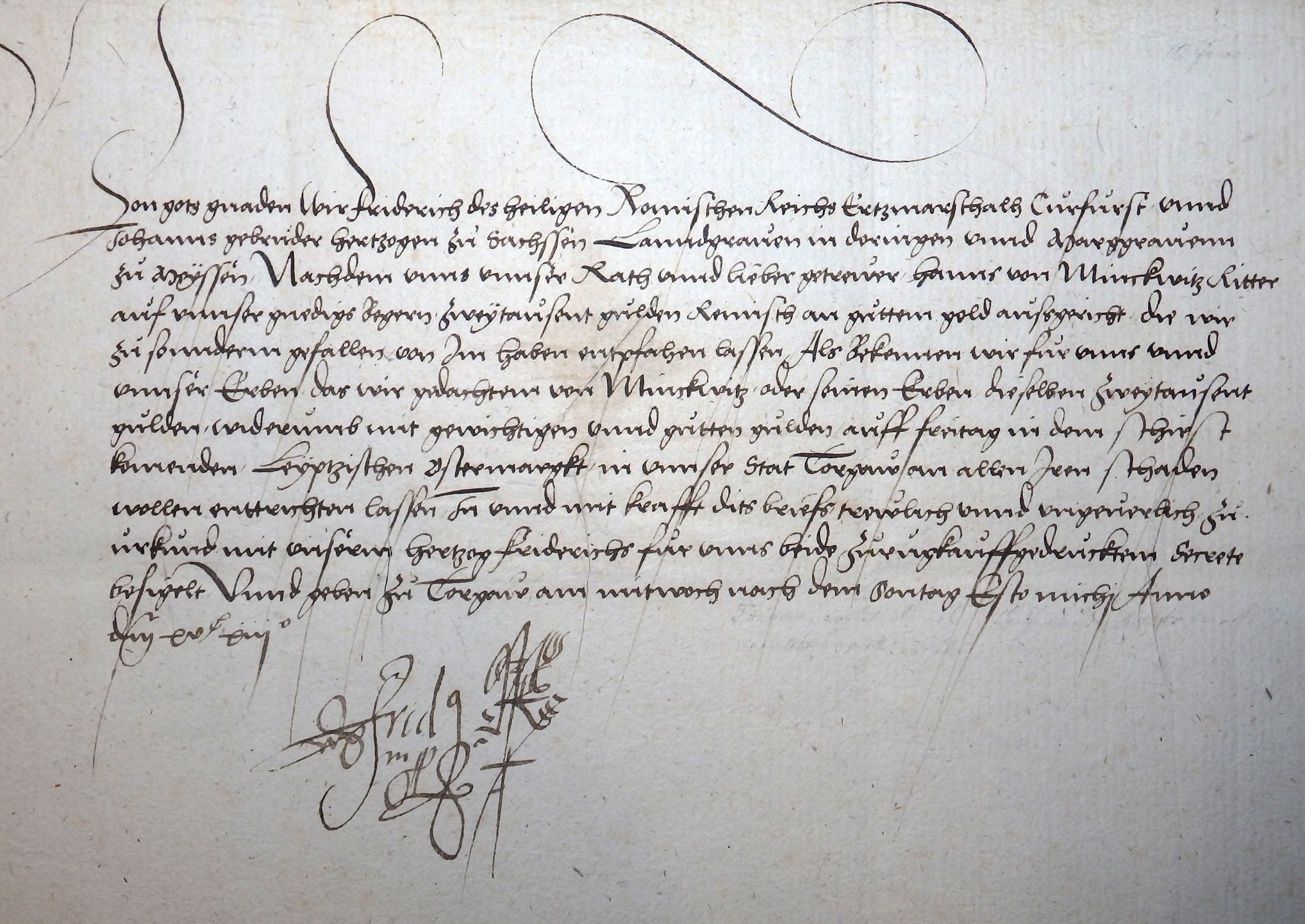
Highly important and extremely rare report of the royal coronation of Maximilian I in Aachen. This exceedingly rare incunable reports on Maximilian’s coronation in Aachen in 1486 and on Frederick III’s writ to Berthold von Henneberg, Archbishop of Mainz, instructing him to have the peace of the land proclaimed publicly. Some events had already taken place on 17 and 28 March 1486, while the implementation of the Common Peace of the Land with the coronation of Maximilian I is to be dated to 30 April 1486; it represented a kind of “constitution” to end uncontrolled acts of war.
The present print belongs to a small group of early political event prints of the Holy Roman Empire. From the 1480s, current imperial events – such as imperial diets, calls for war against the Turks or royal coronations – were disseminated in print for the first time. The present print is one of the earliest printed news reports about a current political event in the Empire. By combining a coronation report with a peace mandate, it also documents the beginning of those imperial reforms which, under Maximilian I, led to the reorganisation of the imperial constitution.
The coronation of Maximilian I took place in Aachen on 9 April 1486. The text of this print, however, mentions events and orders extending up to 30 April 1486. This means that the Strasbourg print by Johann Prüss was produced only a few weeks after the coronation. Given the technical conditions of such early incunable printing, this is remarkably fast. In the late 15th century this meant: news from Aachen, transmission to Strasbourg, typesetting, printing, rubrication and distribution throughout the Empire. The print is, so to speak, a “breaking news” report of imperial politics.
Maximilian’s election was not a political matter of course. His father, Frederick III, had him elected king during his own lifetime in order to secure the dynastic succession of the Habsburgs. The combination of coronation report and peace mandate is no coincidence. For decades the Empire had been debating how feuds and violent conflicts could be ended and how law could be enforced. The print shows the political ambition of the new king: Maximilian appears as the guarantor of order and peace. This approach later led to the reforms of the Imperial Diet of 1495, including the Perpetual Public Peace, the Imperial Chamber Court and the Imperial Circles.
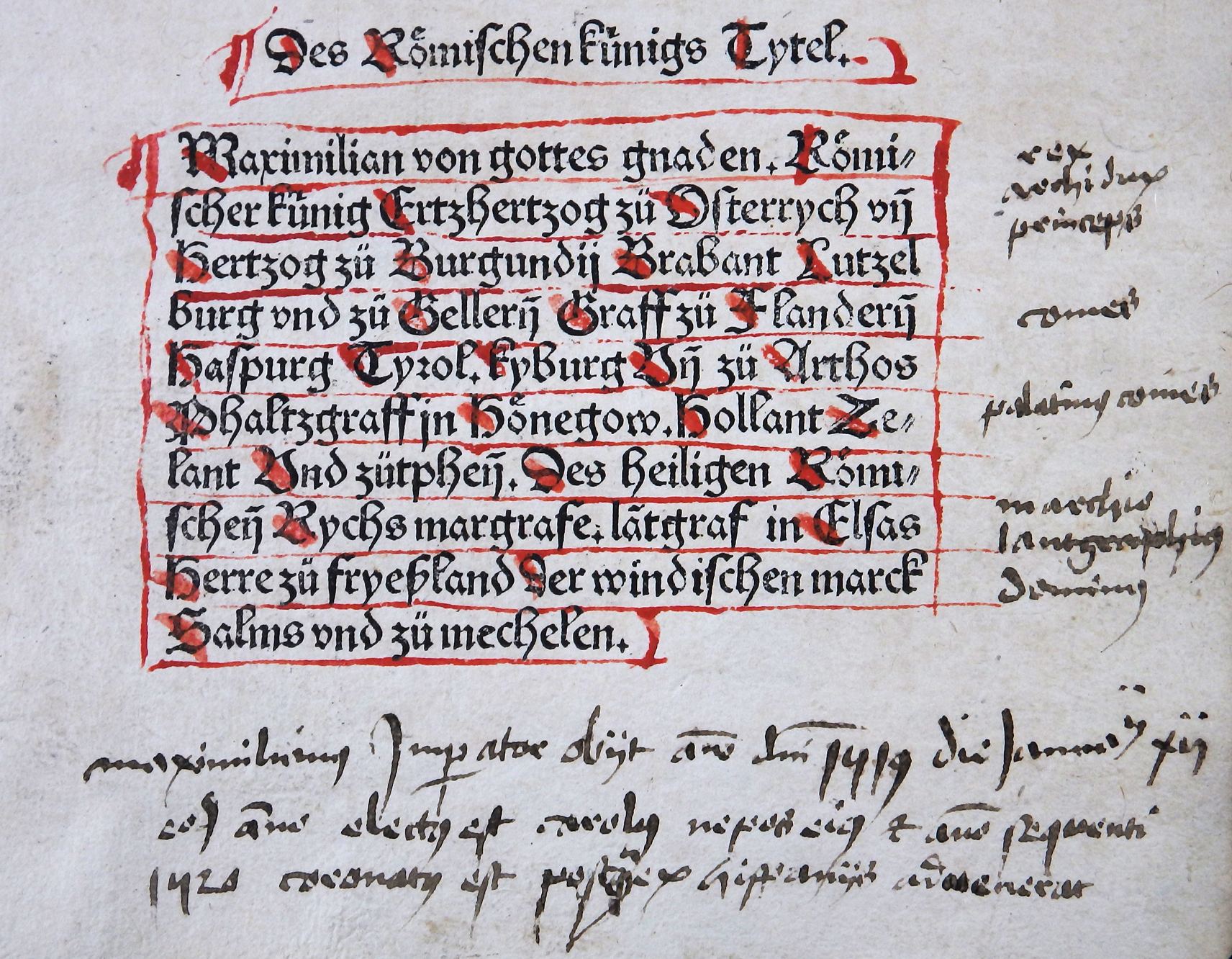
Only four copies of this print can be traced worldwide. What makes the present print particularly interesting are the handwritten Latin comments made around 1520, which turn this copy into an absolutely unique item. On the last leaf, one Antonius Frantz notes:
„Rex archid Princeps comes palatinus comes marchio lantgraphius dominus Maximilianus Imperator diyt anno domino 1519 die January xii. Cos anno electus est carolus nepoß ciuser cius anno quenti 1520 coronatus est post et cetera hispaniis adverierat.“
Translated: “King, Archduke, Prince, Count Palatine, Margrave, Landgrave, Lord Maximilian, Emperor, died in the year of the Lord 1519 on 12 January. In the same year his nephew Charles was elected and crowned in the year 1520, after the heir to the throne had arrived from Spain.”
COLLATION
19 (of 20) leaves. The last leaf c4 blank. Without the first blank leaf a1. Textually complete copy.
Quire signatures: a8; b8; c4.
FEATURES
Single-column Gothic type in 27 lines. Rubricated in red and with numerous handwritten marginal comments and deletions, likewise rubricated in red. Evidence that the rubricator was one of the first owners.
Leaf size: 20.3 x 14.5 cm; type area: up to 14 x 9 cm.
BINDING
Unsewn. Quires loose in a contemporary laid-paper wrapper with a handwritten ownership note and a cross drawing of the period. This copy is therefore preserved in an absolutely genuine state and, unlike the few other copies, historically unaltered.
Quarto: 20 x 14.3 cm.
CONDITION
Genuinely preserved print. Clean and strong impression, perceptible to the touch, on firm laid paper. In the margins. With extensive comments in a contemporary hand. Upper corner with old tear throughout. The first two leaves with marginal tear in the right margin, outside the type area.
REFERENCES
Literature: ISTC im00384300; GW M22101; Zehnacker 1560 (& ill. XI); IDL 3167; Madsen 2424; Proctor 3263; BMC III 860.
Libraries: Royal Library København, Sammlung Draiflessen (Liberna, Inc 41), Mettingen; Duchess Anna Amalia Library, Weimar (Inc.318a.1-3); British Library (IA.1574, not described in BMC)
Trade: no sales in the trade known since 1983.
PROVENANCE
Antonius Frantz – his handwritten ownership entry on the wrapper and his comments throughout the print.
From the possession of Günther Herzfeld-Wüsthoff (1893-1969), German writer, philosopher and antiquarian bookseller. He was in close contact with Thomas Mann and Alfred Andersch, his former mentor, who erected a monument to him in his novel “Kirschen der Freiheit”. In 1935 he bought a plot of land in Unterreitnau in the Lindau hinterland and built a house in which he later founded the publishing house “Trösteinsamkeit”. His daughter Christa Herzfeld-Wüstoff lived in the house until 1995. The present copy comes from this estate.
BUYING CULTURAL PROPERTY SAFELY
We hereby confirm the impeccable provenance of the present incunable. At the time of sale it is free of third-party rights and has been checked against the Lost Art database. An export licence from the cultural authorities is required for delivery outside the EU. We apply for it after receipt of the purchase price; it takes approx. 14 days. No export licence is required for shipment to EU countries owing to the defined value thresholds.
Price
€25,000 *