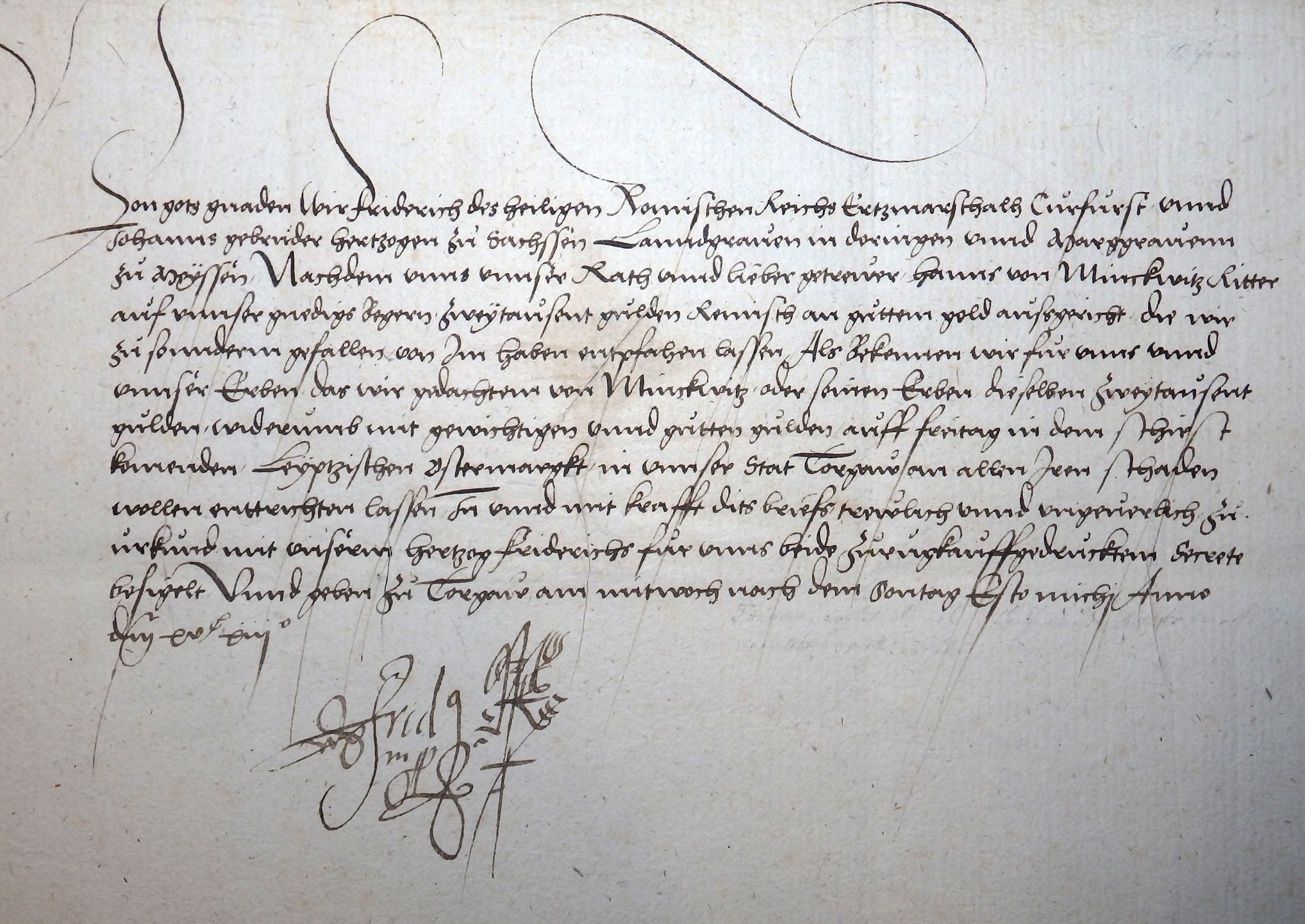
Frederick the Wise, Loan, Torgau, AD 1513
AUTHOR
Frederick the Wise (1463-1525)
Elector of Saxony
TITLE
Loan of 2,000 Rhenish guilders to the knight Hans von Miltitz
ORIGIN
Torgau, probably Hartenfels Castle, 9 March 1513
DESCRIPTION
Exceedingly rare document from the immediate day-to-day government of Frederick the Wise, created in precisely the year in which the Ernestine lands were reorganised administratively and financially.
Manuscript on laid paper with a paper-covered seal on the reverse, which was cut to indicate settlement. A bifolium. Chancery script in brown ink with the autograph signature of Frederick, Duke of Saxony.
Letter from Elector Frederick the Wise to his councillor and faithful servant Hans von Miltitz concerning a loan of 2,000 Rhenish guilders granted by the latter. In the document Frederick confirms receipt of the sum and declares that the funds were used for necessary affairs of his person and his land. To secure repayment, electoral revenues and levies are pledged.
The sum of 2,000 Rhenish guilders was a considerable amount. A Rhenish gold guilder contained approximately 2.5–2.7 g of fine gold, so 2,000 guilders corresponded to roughly 5–5.5 kilograms of gold. At that time a simple day labourer earned about 10–15 guilders and a master craftsman 20–40 guilders per year. 2,000 guilders therefore corresponded to 50 to 100 times the annual income of a prosperous craftsman or several hundred annual incomes of a farm labourer.
The considerable revenues from Saxony’s silver mines and his share of the seigniorage due from the mints of Freiberg, Leipzig, Annaberg, Buchholz, Zwickau, Schneeberg and Langensalza formed an essential basis of the Elector’s financial power. In addition, there was a high need for finance precisely at this time of restructuring. The document expressly mentions the pledging of revenues and levies for repayment. This points to a classic late medieval annuity transaction or a secured loan. It can be regarded as a forerunner of today’s government bonds.
The document is one of the rare surviving examples of a credit obligation taken up by an imperial prince and secured by sovereign revenues. It thus documents early forms of state financing in the Holy Roman Empire immediately before the beginning of the Reformation.
HISTORICAL BACKGROUND
Frederick the Wise was Elector of Saxony from 1486 until his death in 1525. The University of Wittenberg, which he founded in 1502, developed over the following decades into one of the most important universities. He was also known as a great patron of the arts: he generously supported Albrecht Dürer and Lucas Cranach. As a result of the Partition of Leipzig in 1485 between the Ernestine-Thuringian and Albertine-Meissen lines of the Wettins, undertaken by his father Ernest and his brother Albert, Frederick developed Torgau into his principal residence.
The document dates from a politically and financially significant phase of Ernestine history. In 1513 the so-called Mutschierung (division of administration) took place between Elector Frederick the Wise and his brother John the Steadfast. This reorganisation of the joint Wettin possessions required extensive administrative, financial and property arrangements and led to considerable liquidity needs within the Electoral Saxon government. Against this background, taking out a loan from the innermost circle of the sovereign’s nobility appears particularly plausible. In the document Hans von Miltitz is expressly referred to as “our councillor and dear faithful servant” and thus belonged to the Elector’s immediate circle. The von Miltitz family is one of the oldest and most important noble families in Saxony. A knight Dietrich von Miltitz is documented as early as 1186 – and in the 14th century members of the family still appear as important landowners and founders of ecclesiastical properties.
The loan thus documents not only a remarkable financial transaction within the Electoral Saxon administration, but also the close economic and political ties between the Wettin ruling house and the Saxon nobility immediately before the beginning of the Reformation. Only four years later, Frederick the Wise was to become one of the defining figures of European history through his protection of Martin Luther.
TRANSCRIPT
Translation of the loan from Old German into modern language:
“We, Frederick III, by the grace of God Duke of Saxony, Arch-Marshal of the Holy Roman Empire and Elector, Landgrave in Thuringia and Margrave of Meissen, publicly declare with this letter that we have today received from our faithful follower Hans von Miltitz, knight, 2,000 Rhenish guilders in good and generally valid coin, which we have used for necessary affairs of our person and our land. As security we pledge to him and his heirs our revenues and levies, from which repayment shall be made annually until the said sum has been repaid in full. In witness whereof we have signed this letter with our own hand and affixed our hereditary seal. Given on the Thursday after the day of Saint Apollonia, in the year 1513 after the birth of Christ.”
DIMENSIONS
Bifolium: 44 x 30.5 cm
Text area 9 x 21 cm
Seal diameter: 2 cm
CONDITION
Very good state of preservation. Slightly browned. Firm laid paper.
PROVENANCE
Werner Deichmann collection (1931–2025), Solingen, a private collection specialising in historical shares, bonds and securities. The document had been in his private possession for decades.
ACQUIRING CULTURAL PROPERTY SAFELY
We hereby confirm the originality and impeccable provenance of the present document. At the time of sale the object is free of third-party rights and has been checked against the Lost Art Register. An export licence from the German cultural authorities is required for delivery outside the EU.
Price
€7,500